research

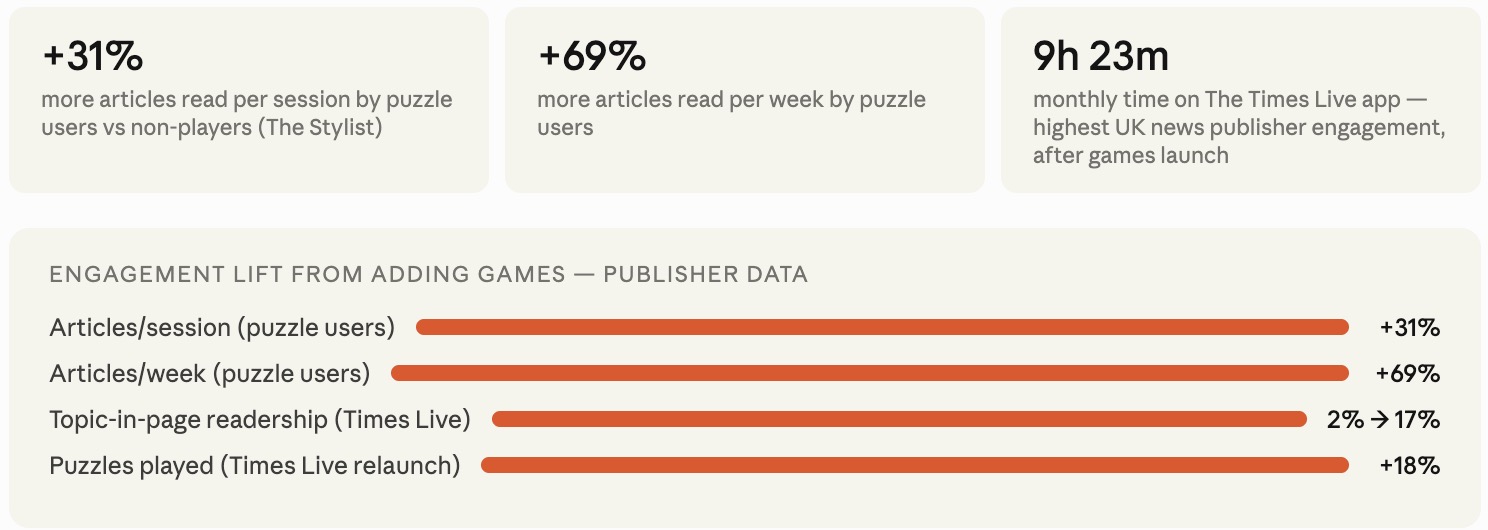
The Stylist Effect: Real Publisher Data On What Happens When You Add a Puzzle

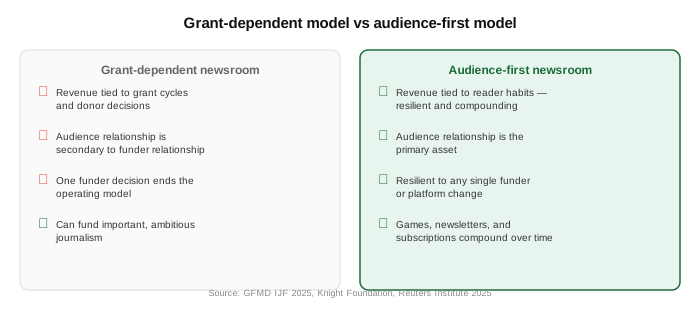
The message that emerged from the funding-focused sessions was blunt: journalism that depends on any single funder, be it government, philanthropic, or corporate – is one decision away from a crisis. The dependency itself is the vulnerability, regardless of how well-intentioned the funder is or how important the journalism.

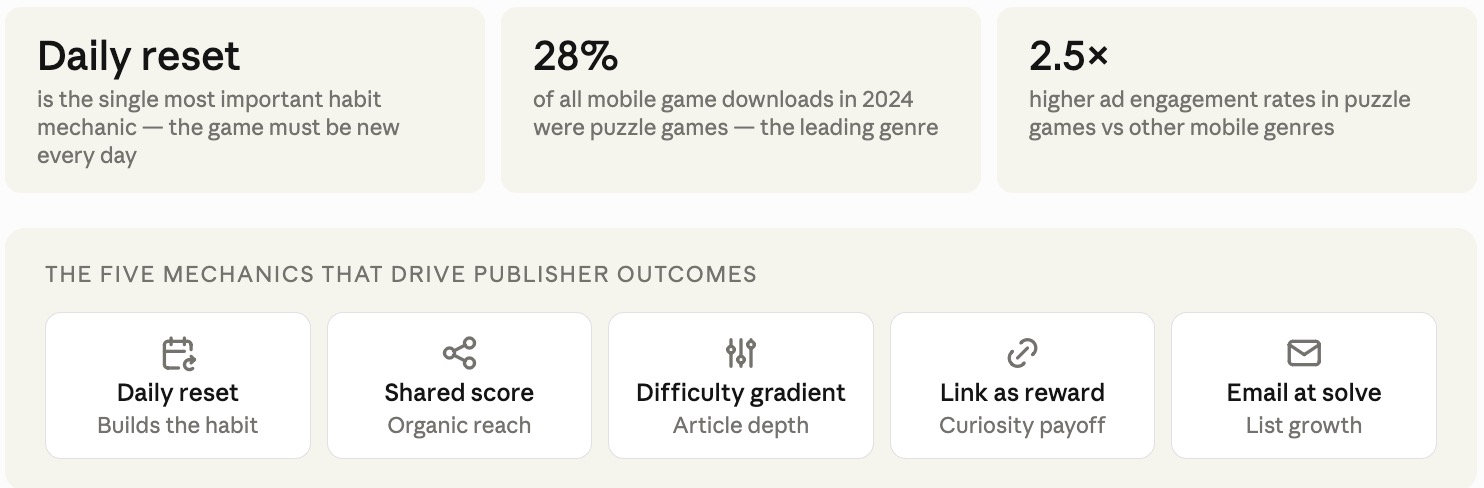
The Five Design Decisions That Make a News Game Work — and the Three That Sink It

The failures are as instructive as the successes. Three mistakes account for the majority of news games that fail to produce publisher outcomes.

Why Philanthropy Cannot Save Local News Alone — and What Sustainability Actually Looks Like

The message that emerged from the funding-focused sessions was blunt: journalism that depends on any single funder, be it government, philanthropic, or corporate – is one decision away from a crisis. The dependency itself is the vulnerability, regardless of how well-intentioned the funder is or how important the journalism.

The NYT Didn’t Intentionally Set Out To Become a Games Company. Local Publishers Should.

Nobody at the New York Times sat down in 2020 and said: we are going to become a games company. The strategy emerged through a sequence of distinct decisions — the crossword subscription, the Cooking app, the Wordle acquisition, The Athletic — each of which made sense on its own terms, and whose collective effect only became apparent in retrospect.

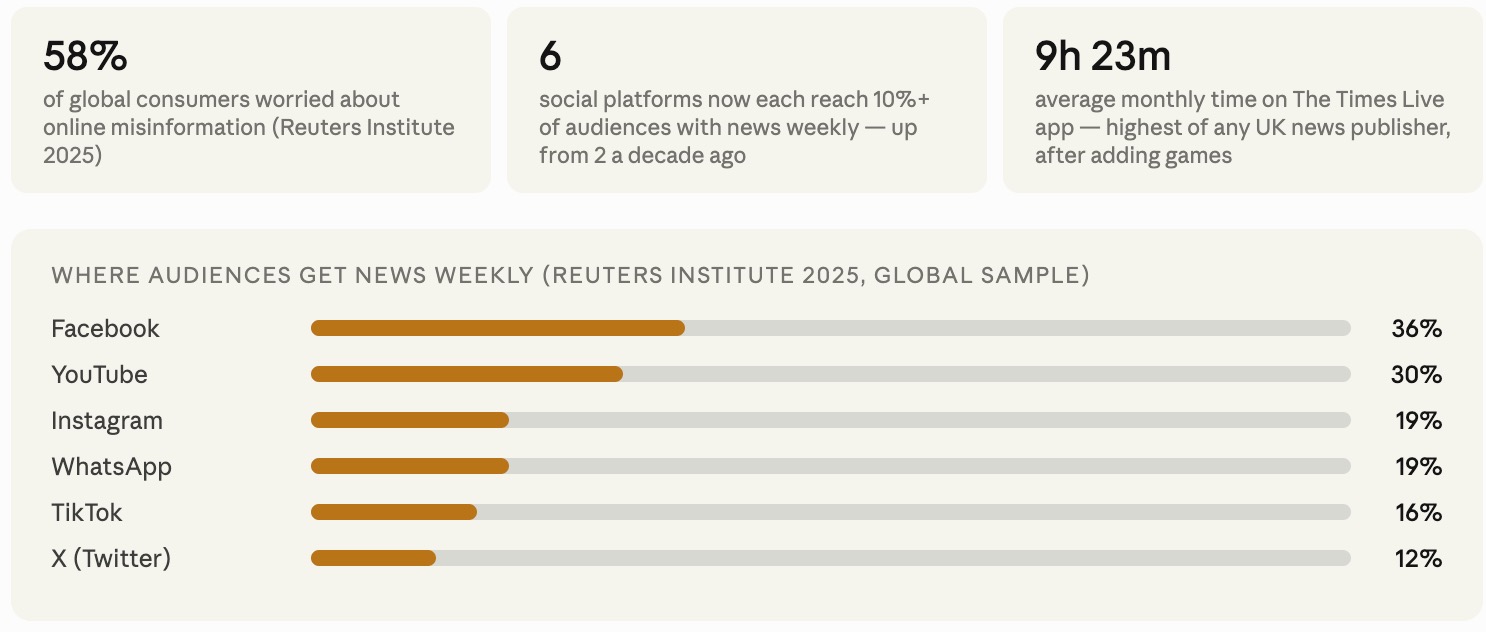
Trust Is Still Journalism’s Superpower. A Daily Game Quietly Rebuilds It.

One of the underappreciated benefits of a daily game as an entry point is that it does not require the reader to have an opinion about your editorial stance. A reader who disagrees with your coverage of a local political issue will still play your crossword about their town. A reader who is fatigued by hard news will still engage with a puzzle. The game is politically neutral, anxiety-free, and genuinely fun — which gives it access to audiences that journalism alone cannot reach.

Why Your Crossword Clue Should Live Inside the Article — Not Outside It

There is a psychological dynamic at work in a well-constructed article-linked clue that is worth naming: curiosity debt. When a clue creates a question the player cannot answer without reading the source material, the player is in a state of motivated uncertainty. They want to know. The article is the only place to find out. The clue has created a debt of curiosity that the article pays off.

The Three Legs of Local News Revenue Broke. Here is What is Left Standing

The revenue crisis that has been going on for years  The three legs of local news revenue broke. Here is what is left standing. Print advertising. Digital display. Social referral traffic. All three collapsed inside a decade. This is not a content quality crisis — it...

How Wordle Supercharged the New York Times – and What Local Publishers Can Learn From It

The NYT spent low seven figures on a free word game and added nearly 3 million digital subscribers in two years. Here is the actual mechanism, and why it translates directly to community newsrooms. First: The Bet That Nobody Believed By Dave LaFontaine In January...

The “News Avoider” is Not Who You Think — and a Daily Game Might Be the Bridge Back

The news avoider is not who you think — and a daily game might be the bridge back Millions of people have stopped opening news apps. But research shows they haven't stopped caring about their communities — they're just consuming news indirectly, and a low-stakes daily...

Trust Is Still Journalism’s Superpower. A Daily Game Quietly Rebuilds It.

Trust Is Still Journalism’s Superpower. A Daily Game Quietly Rebuilds It.

One of the underappreciated benefits of a daily game as an entry point is that it does not require the reader to have an opinion about your editorial stance. A reader who disagrees with your coverage of a local political issue will still play your crossword about their town. A reader who is fatigued by hard news will still engage with a puzzle. The game is politically neutral, anxiety-free, and genuinely fun — which gives it access to audiences that journalism alone cannot reach.

read more...
breakdown of stats about why games should work with your news content not live in a separate ecosystem

Why Your Crossword Clue Should Live Inside the Article — Not Outside It

There is a psychological dynamic at work in a well-constructed article-linked clue that is worth naming: curiosity debt. When a clue creates a question the player cannot answer without reading the source material, the player is in a state of motivated uncertainty. They want to know. The article is the only place to find out. The clue has created a debt of curiosity that the article pays off.

read more...

contact us

Recent research

Our combined experience in designing games, working with local news publishers, and consulting with news organizations around the world has given us deep expertise in what is working - and what publishers should to to innovate during a time of such wrenching change. 

We think you will find this useful ... 

The Stylist Effect: Real Publisher Data On What Happens When You Add a Puzzle

The Stylist Effect: Real Publisher Data On What Happens When You Add a Puzzle

The message that emerged from the funding-focused sessions was blunt: journalism that depends on any single funder, be it government, philanthropic, or corporate – is one decision away from a crisis. The dependency itself is the vulnerability, regardless of how well-intentioned the funder is or how important the journalism.

The NYT Didn’t Intentionally Set Out To Become a Games Company. Local Publishers Should.

The NYT Didn’t Intentionally Set Out To Become a Games Company. Local Publishers Should.

Nobody at the New York Times sat down in 2020 and said: we are going to become a games company. The strategy emerged through a sequence of distinct decisions — the crossword subscription, the Cooking app, the Wordle acquisition, The Athletic — each of which made sense on its own terms, and whose collective effect only became apparent in retrospect.
Trust Is Still Journalism’s Superpower. A Daily Game Quietly Rebuilds It.

Trust Is Still Journalism’s Superpower. A Daily Game Quietly Rebuilds It.

One of the underappreciated benefits of a daily game as an entry point is that it does not require the reader to have an opinion about your editorial stance. A reader who disagrees with your coverage of a local political issue will still play your crossword about their town. A reader who is fatigued by hard news will still engage with a puzzle. The game is politically neutral, anxiety-free, and genuinely fun — which gives it access to audiences that journalism alone cannot reach.
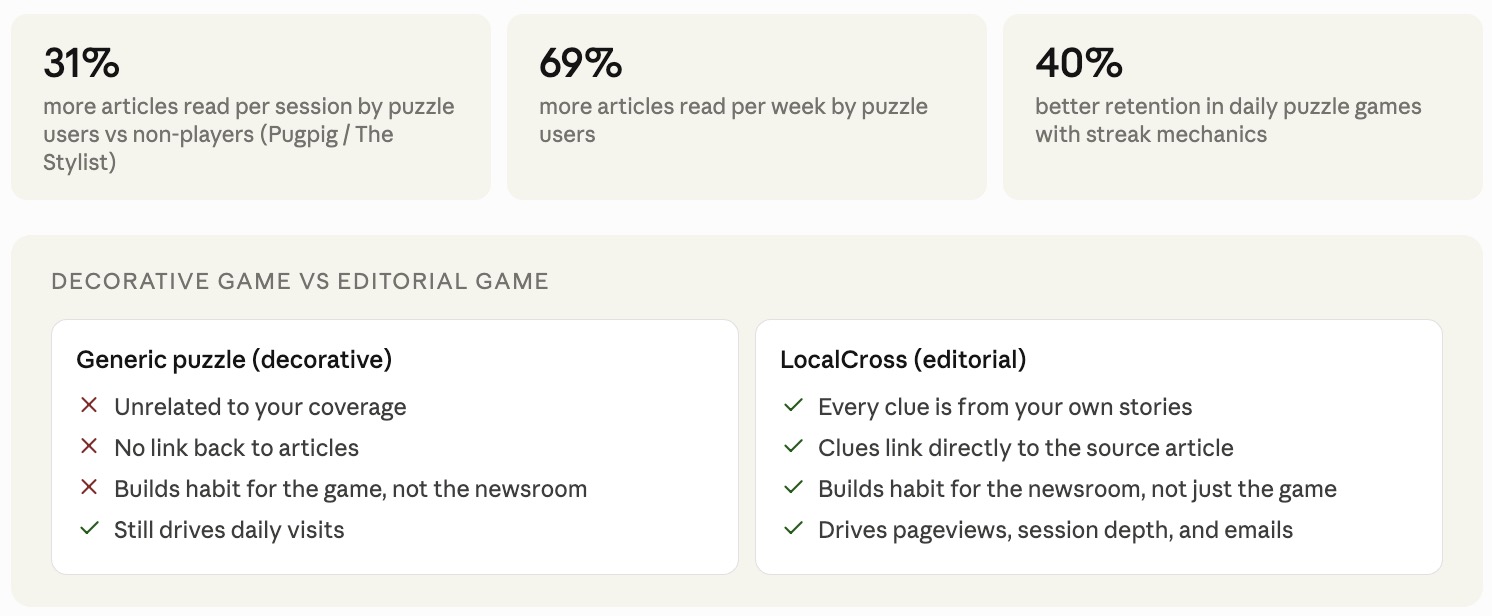
breakdown of stats about why games should work with your news content not live in a separate ecosystem

Why Your Crossword Clue Should Live Inside the Article — Not Outside It

There is a psychological dynamic at work in a well-constructed article-linked clue that is worth naming: curiosity debt. When a clue creates a question the player cannot answer without reading the source material, the player is in a state of motivated uncertainty. They want to know. The article is the only place to find out. The clue has created a debt of curiosity that the article pays off.