
There is a difference between a sundicated game, and one built especially for a local publisher
The Five Design Decisions That Make a News Game Work — and the Three That Sink It
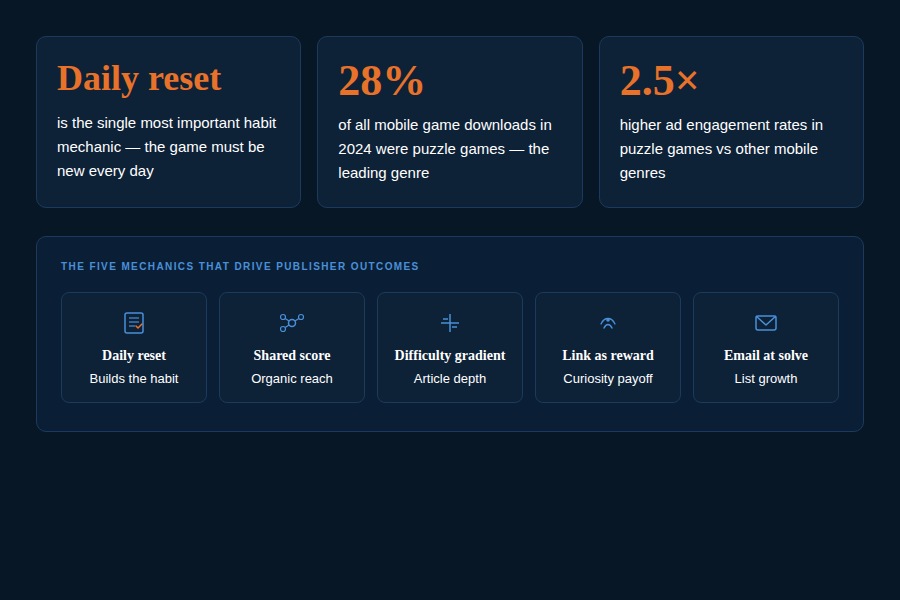
Not all games drive publisher outcomes. The ones that do share five specific design choices. The ones that fail tend to make the same three mistakes. This is what to look for when you are evaluating a games product.
Decision one: daily reset
The single most important habit mechanic in any news-adjacent game is the daily reset. The game must be new every day. Not weekly. Not on-demand.
Not randomly generated when you choose to play.
Every morning, at the same time, a new puzzle appears, and yesterday's is gone.
This sounds simple. It is also the reason Wordle worked when similar word games had existed for years without achieving the same cultural traction. The daily reset creates a shared experience - everyone playing today's puzzle is playing the same puzzle - and it creates urgency. There is a reason to play today that will not exist tomorrow.
For a publisher, the daily
reset is the mechanism that turns a game into a daily visit. Puzzle games with daily challenges show 40 percent better retention than those without. The reset is not a feature. It is the foundation.
Decision two: shared score
Wordle's shareable grid of colored squares was not incidental to its success. It was the distribution mechanism. Every player who shared their result on social media was, effectively, a free adve
rtisement for the game; one that came with a social proof signal (my friend plays this) and a challenge (can you do as well?).
For a local news game, the shared score has an additional dimension. Sharing your result on a crossword about your town is sharing something about your town. It is a community signal as well as a game signal. Local publishers who have integrated shareable results into their games report meaningful organic reach within their communities — reach that is qualitatively different from standard social media promotion because it comes from within the community, not from the publisher.
Decision three: difficulty gradient
A puzzle that is only difficult loses casual players before they develop the habit. A puzzle that is only easy loses the deeper engagement that drives article click-through. The right design uses a gradient — easy clues that get players started, medium clues that require reading, hard clues that reward close engagement with the coverage.
The three-level model maps directly to engagement depth. Easy clues (answered from the headline or first paragraph) expose the player to the story without requiring them to read it. Medium clues (requiring article body text) drive traffic. Hard clues (implied, requiring context) create the most memorable solves and the strongest motivation to understand the underlying story. Every difficulty level is a different kind of journalism engagement.
Decision four: the link as reward, not penalty
The article link cannot feel like homework. If the game interrupts play to say "you need to read this article to continue," most players will close the tab. The link has to feel like the payoff; the thing you want to click after a satisfying solve, because the clue made you curious about the story behind the answer.
This is a design and sequencing question, not just an editorial one. The link appears after the solve, when the game is done. It is presented as the source of the answer the player just found; not as a requirement, but as the explanation of something they now find genuinely interesting. The curiosity the clue created, the game satisfied. The article deepens it.
Decision five: the email ask
There is one moment to ask for an email address, and it is immediately after a successful solve. The player is at peak satisfaction. The game has just given them something. They are, briefly, in a state of mild gratitude and goodwill toward the publisher. This is the moment to ask. Not before, not during, not in a separate prompt later.
The ask should not be a gate. Anyone who wants to skip it should be able to. But it should be present, visible, and paired with a clear newsletter opt-in that describes what the subscriber will receive. A well-designed email capture at this moment can achieve conversion rates that most publishers have never seen from any other acquisition mechanism.
The three mistakes that sink news games
The failures are as instructive as the successes. Three mistakes account for the majority of news games that fail to produce publisher outcomes.
First: unrelated content. A game that has no connection to the publisher's journalism (such as a generic puzzle syndication) passes the time but creates no editorial value. The player builds a habit around the game, not around the newsroom. When the publisher asks for a subscription, the game provides no reason to say yes.
Second: mandatory login before play. Requiring an account before the first game destroys the top of the funnel. Most potential players will not create an account for something they have never tried. The NYT's decision to keep Wordle free and ungated was the correct one. The email ask comes after the solve, when the player has already received value, not before.
Third: clues that are answerable without the article. If a player can guess the answer from general knowledge or context without reading the source story, the game has failed its primary editorial purpose. Every clue must be specific enough that it requires the article. That specificity is the editorial discipline that makes the game work.