
FUNDING CRISIS
Why Philanthropy Cannot Save Local News Alone — and What Sustainability Actually Looks Like
After USAID cuts and shifting donor priorities, journalism funders at IJF 2025 were direct: project grants are not a business model. Audience revenue is the only durable floor. Here is what that means in practice.
The scene at Perugia
Every April, the International Journalism Festival in Perugia brings together the people who make, fund, and study journalism from around the world. In 2025, funding and sustainability dominated the conversation in a way that felt different from previous years — less diagnostic, more urgent. The USAID funding cuts had forced a reckoning that everyone in the room already knew was coming but had been able to defer. Now it was here.
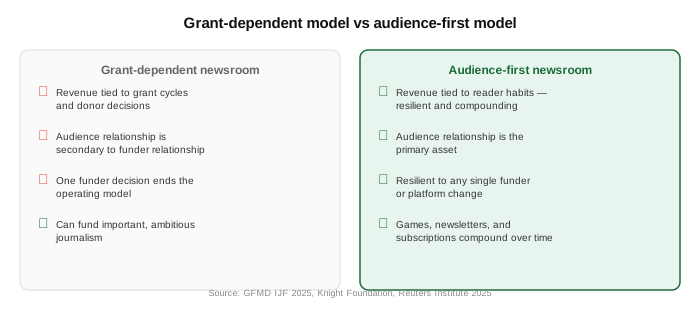
The message that emerged from the funding-focused sessions was blunt: journalism that depends on any single funder, be it government, philanthropic, or corporate - is one decision away from a crisis. The dependency itself is the vulnerability, regardless of how well-intentioned the funder is or how important the journalism.
What the USAID shock revealed
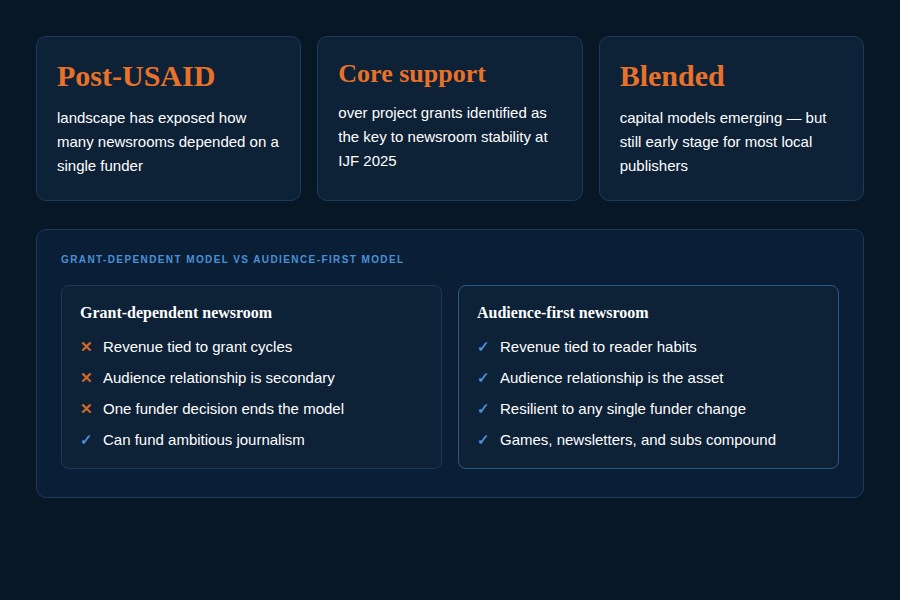
The reduction of USAID funding exposed how many independent newsrooms had built their operating models around a single large source of grant funding. When that source dried up, the downstream effects were immediate and severe.
This is not a criticism of those newsrooms. Grant funding has long enabled important journalism that would otherwise not have existed. But the IJF 2025 sessions were explicit: long-term core support beats project-based grants as a sustainability model, and core support from any single source is itself a fragile foundation. The only genuinely resilient model is one where audience revenue forms the floor — the base that cannot be removed by a single external decision.
What journalism funders recommend
The sessions at Perugia identified several directions worth tracking. Impact investing — blended capital that combines financial returns with positive social outcomes — was discussed as a potential new frontier for journalism funding. Collaboration between newsrooms was identified as a mechanism to share costs and accelerate innovation. Taxing large technology companies to fund journalism was on the agenda, with several European jurisdictions already pursuing versions of this model.
But the thread running through all of these was the same: none of them work without an engaged audience at the foundation. Impact investors need evidence of audience relationships to assess the social return on their investment. Collaboration works best between newsrooms that are each independently viable. Tech taxes produce a pool of money, but the newsrooms best positioned to access it are the ones that can demonstrate audience value.
Audience engagement is not one pillar of sustainability among several. It is the precondition for all of the others.
If nobody is engaged with the news you are producing … what is the point?
Impact investing: promising but early-stage
The impact investing model is genuinely interesting for local journalism, but it is not a 2025 solution for most community publishers. The infrastructure — the investors, the intermediaries, the measurement frameworks — is still being built. The newsrooms best positioned to access this capital in the next few years are those that can demonstrate clear financial strategies, diversified revenue streams, and evidence of audience engagement.
In other words: building a sustainable audience-first model now is the best preparation for accessing impact investment later. The two strategies are not alternatives. They are sequential.
The audience revenue case
A subscriber who arrives through a daily game is different from one who arrives via a grant-funded audience acquisition campaign. Meanwhile, a game player has built a habit before they were asked to pay. Their subscription is the formalization of a relationship, not a response to a promotional moment. Churn rates for this kind of subscriber tend to be lower, because the habit the game created persists after the subscription begins.
The compounding nature of this matters. An email list built through a daily game grows with each new player. The newsletter open rates among game-sourced subscribers tend to be higher than those from other acquisition channels, because the daily game habit has already primed the reader to expect daily contact from the publisher.
And none of it depends on a grant cycle, a donor decision, or a platform algorithm. The Knight Foundation's Catalyst program has identified audience-first revenue models as a priority for local news sustainability precisely because they build the kind of durable foundation that grant funding cannot. The game is not a distraction from the sustainability mission. It is the sustainability mission.