
The revenue crisis that has been going on for years
The three legs of local news revenue broke. Here is what is left standing.
Print advertising. Digital display. Social referral traffic. All three collapsed inside a decade. This is not a content quality crisis — it is a distribution and revenue-model crisis. And the data points to one structural fix: owning the daily habit.
Leg one: print advertising
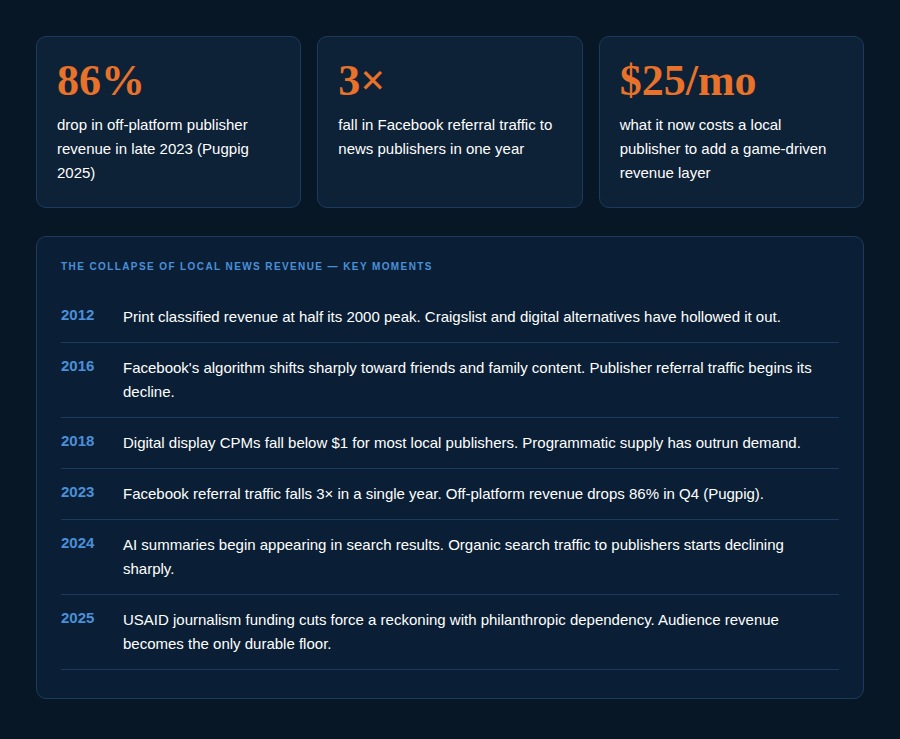
The collapse of print advertising is the one most publishers have already processed. It took the better part of two decades, which made it feel gradual — but by the early 2020s, print ad revenue for local publishers had fallen to a fraction of its 2000 peak.
What is less discussed is what went with it: the classified ads that funded community journalism for generations. Craigslist did not just kill a revenue line. It removed the financial relationship between local commerce and local journalism.
Most publishers adapted by moving online. But online turned out not to be the salvation it appeared.
Leg two: digital display advertising
Digital display advertising looked, for a moment, like the replacement. Page views were measurable. Advertisers could target by geography and interest. Local publishers could, in theory, compete for ad dollars that used to flow to print.
In practice, programmatic advertising collapsed CPMs — the price per thousand ad views — as the supply of ad inventory exploded across the web. Publishers with small, loyal local audiences found themselves competing in a market that rewarded scale above all else. Google and Facebook captured the majority of digital ad spend. Local publishers got the remainder, at rates that made the economics increasingly difficult to justify.
The digital display bet did not pay off. It created dependency on platforms that were indifferent to local journalism's survival.
Leg three: social referral traffic
The third leg broke fastest.
Social media — particularly Facebook — had become the primary distribution channel for many local publishers. It was free, it reached large audiences, and it drove traffic that could be monetised through display ads. Publishers built editorial and distribution strategies around it.
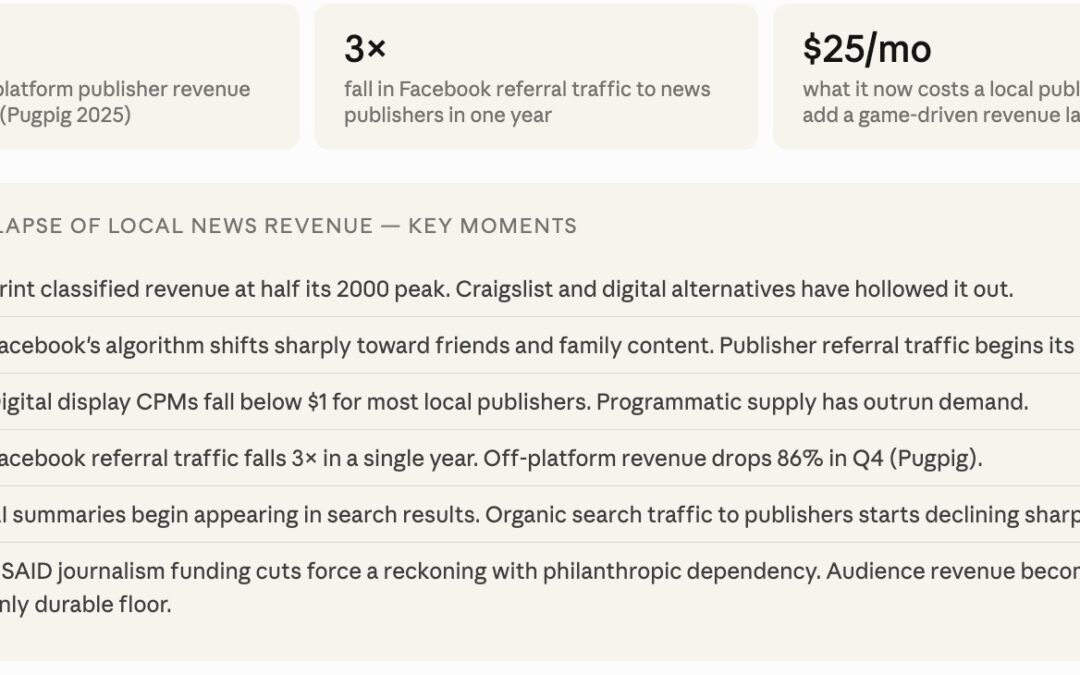
Then Facebook changed its algorithm. And changed it again. And again. Each change reduced the organic reach of publisher content. Then, in a single year, referral traffic from Facebook to news publishers fell by a factor of three. Off-platform publisher revenue dropped 86 percent in the final quarter of 2023.
And then came AI. Search, which had held up reasonably well through the social collapse, began to erode as AI summaries started appearing at the top of results pages, answering questions without the user needing to click through to the source. Organic search traffic — the last reliable free distribution channel — began its own decline.
The platforms were never partners. They were distribution channels that publishers did not control, and they behaved accordingly.

What is still working
The publishers who are navigating this most successfully have one thing in common: they are investing in owned channels, such as apps, newsletters, and direct traffic - rather than platform-dependent distribution. Audiences who come to you by habit rather than by algorithm are the only durable base. You cannot be algorithm'd out of a relationship your reader has built directly with your site.
This is where a daily game becomes a structural argument, not a gimmick. A reader who visits your site every morning to play a crossword built from your own stories is a direct-traffic user. Their visit is not mediated by any platform. Their email address is yours. Their habit is built around your journalism.
The GFMD roundup from the International Journalism Festival 2025 in Perugia was direct on this point: collaboration accelerates innovation, but the foundation of sustainability is audience engagement — meeting readers where they are and giving them a reason to stay.
First-party data as the new oil
The collapse of third-party cookies (combined with Apple's App Tracking Transparency changes) made first-party data the most valuable asset in digital publishing. An email address collected from a willing subscriber is worth more, in terms of long-term monetizable value, than hundreds of pageviews from an anonymous social referral.
A daily game that captures an email at the moment of a successful solve, with a visible newsletter opt-in, not a mandatory gate ... that is a first-party data machine. Every player who finishes your crossword and signs up for your newsletter is a relationship you own outright. No platform can take it away.
The math is worth doing. Flat plans from $25 a month cover the game's hosting and puzzle generation. One local sponsor on the game can cover that subscription many times over.
A share of LocalCross' ad revenue comes back to the publisher monthly. The email list the game builds is a compounding asset.
None of these revenue lines depend on a grant cycle or an algorithm.