The news avoider is not who you think — and a daily game might be the bridge back
Millions of people have stopped opening news apps. But research shows they haven't stopped caring about their communities — they're just consuming news indirectly, and a low-stakes daily game is a different kind of entry point.
Who news avoiders actually are
The phrase "news avoider" conjures a particular image: someone checked out, disengaged, wilfully uninformed. The data tells a more complicated story.
Research published by the Columbia Journalism Review found that so-called news avoiders are not really skipping out on the news at all. They have alternative, often indirect sources of information — friends, social conversations, podcasters, ambient awareness.
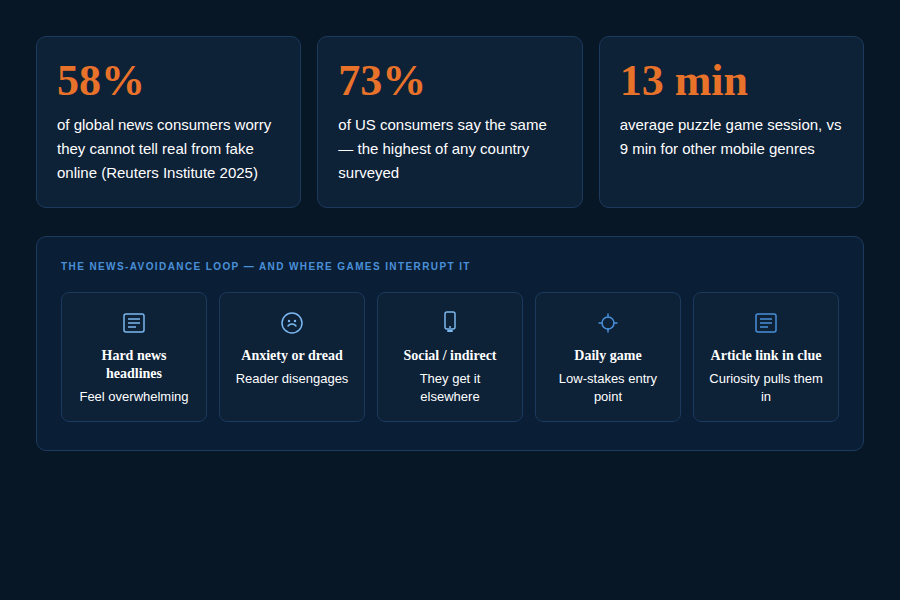
The attitude is less "I don't care" and more "I'll hear about it eventually." They are still connected to their communities. They are just not coming to publishers for that connection. The reasons vary. For some it is anxiety — the relentless cadence of hard news creates a feeling of dread that makes opening an app feel like a punishment.
For others it is time. For others still, it is a creeping sense that the news they receive is not really about them or their community. The Reuters Institute 2025 Digital News Report found that growing numbers of people are selectively — and in some cases consistently — avoiding the news.
This is not a niche behavior. It is accelerating across age groups and markets.
 Photo by Tony Tran on Unsplash
Why hard news pushes people away
There is a design problem at the heart of how most news is delivered. Headlines are optimised for urgency and consequence. The implicit message of most news apps is: something bad is happening, you should know about it, here is more bad news below.
For readers who are already stressed, that experience is actively unpleasant. The news-avoidance response is rational. If consuming news makes you feel worse, you consume less of it. This is not a failure of journalism — it is a failure of the delivery mechanism. The journalism may be important, accurate, and locally relevant.
The experience of receiving it is still aversive. What is needed is a format that creates a different first feeling. Something that does not lead with consequence and urgency. Something that gives the reader a sense of agency and completion rather than dread and overwhelm.
The neutral format advantage
A puzzle makes no political demands. It does not ask you to feel anything about a headline. It presents a small, solvable challenge with a tidy answer at the end. The emotional experience is almost the exact inverse of a hard news digest.
This matters because it widens the aperture of who you can reach. A reader who would never click a headline about the city council vote will still play a daily crossword about their town — especially if the clues are genuinely local. The puzzle is the packaging. The journalism is the substance inside it. The indirect news consumer — the person who says "I'll hear about it eventually" — is not hostile to local coverage.
They are just looking for a different kind of on-ramp. A daily game that is built from your own stories and resets every morning is exactly that on-ramp. It meets people where they are, in a format they already use, without leading with anxiety.
The game-to-story bridge
The critical design question is what happens after the solve. A game that entertains and disappears does nothing for a publisher. A game where the clues are built from real articles, and where those articles are linked from inside the game, does something structurally different. When a player encounters a clue about the new bridge on Main Street, or the school board meeting, or the flooding on Elm Street, and cannot immediately answer it, the natural response is curiosity.
That curiosity is a kind of debt — the player owes the article a visit to get the answer. The game creates the interest; the journalism pays it off.
And critically, the link appears after the solve — at the moment of maximum satisfaction, when the player is not anxious or overwhelmed, but pleased with themselves and curious about the world. That is a fundamentally different mental state from clicking a headline in a news feed, and it produces meaningfully different engagement.
Research from the Pugpig 2025 Media App Report bears this out. Publishers who added games found that puzzle users read significantly more articles per session and per week than non-players. The game does not distract from the journalism. It primes the reader for it.
A crossword clue is still journalism
There is sometimes an anxiety among publishers that games are somehow beneath their mission. That editorial credibility requires staying in the lane of hard news delivery, and that anything lighter is a compromise.
A better way to think about it: a clue that tells a reader to find the name of the engineer behind the new flood barrier in this morning's infrastructure story is journalism. It is a different format, but it is doing the same work — making local news discoverable and relevant to people who live in the community it covers.
The news avoider is not lost. They are just waiting for a reason to come back that does not feel like homework. A daily game built from your own stories is that reason.