
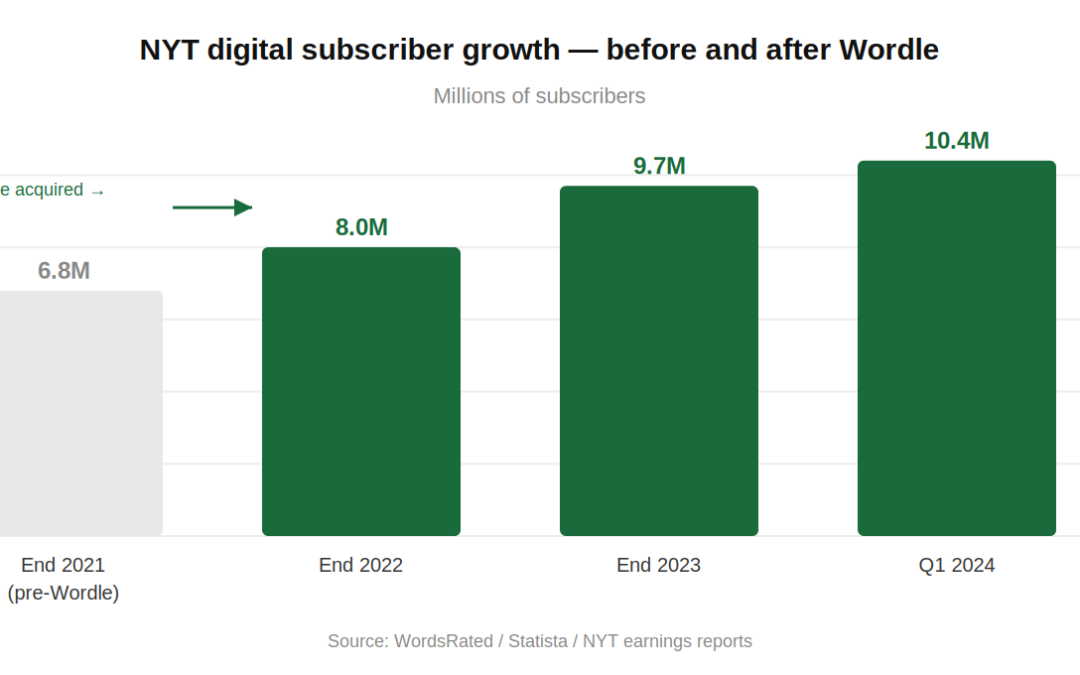
The NYT spent low seven figures on a free word game and added nearly 3 million digital subscribers in two years.
Here is the actual mechanism, and why it translates directly to community newsrooms.
First: The Bet That Nobody Believed
In January 2022, the New York Times paid somewhere in the low seven figures for a game to add to their growing "Puzzles" section.
Not a news product. Not a podcast. Not an investigative unit. A word game that reset every day and took about three minutes to play. The people who ran it had no staff. The game had no ads. It charged nothing. The Times bought it anyway.
At the time, plenty of smart people thought it was a strange use of money. The Times had a journalism operation to fund. It had reporters, editors, printing presses, a paywall to defend. Why spend millions on something you were going to keep giving away?
Sure, newspapers had long had crossword puzzles and other games in their print editions - people actually make it a point of pride when they "can do the Times crossword puzzle using an ink pen, not a pencil!"
Two years after they bought it, the Wordle page alone accounted for 82 percent of the Times's total organic search traffic. The games app was pulling in two million dollars a month on iOS. Digital subscribers had grown by nearly three million — a 43 percent jump since the acquisition. Games were, by time spent, the single biggest product the Times had. Bigger than the news.
The bet had worked. And almost nobody had seen it coming — including, by most accounts, the Times itself. That is the part worth paying attention to if you run a local newsroom.
Why free was the whole strategy
When Wordle moved to the Times, the critical decision was to keep it free. No paywall. No login required. No subscription prompt before the first play. The game was a front door, not a revenue line — at least not directly.
This confused people. The Times was spending real money on user acquisition through a product that charged nothing. But the logic was straightforward once you saw it: Wordle brought tens of millions of new users to the Times domain who had never been there before. Many of them stayed to explore. A meaningful share signed up for games subscriptions. A further share converted to full news subscribers.
The game was the top of a funnel that had never existed before. Free was not generosity. Free was the business model.
For a local newsroom, the parallel is direct. A daily crossword built from your own stories and hosted on your own domain — free to play, no subscription required — gives people a reason to visit your site who would never have opened a headline. Once they are there, you have a relationship to build.
The habit loop, and why it works
Wordle is not complicated. You get six tries to guess a five-letter word. The game resets every day. Everyone in the world plays the same puzzle on the same day. When you finish, you get a shareable grid of coloured squares.
Those four design choices — daily reset, universal puzzle, limited attempts, shareable result — are not accidents. They are the mechanics of habit formation. The daily reset gives you a reason to come back tomorrow. The universal puzzle gives you something to talk about with other people. The limited attempts create stakes. The shareable result turns every player into a distribution channel.
Research on puzzle game engagement confirms the pattern. Puzzle games with daily challenges show 40 percent better retention than those without. Players average 13 minutes per session — significantly above the nine-minute average for other mobile gaming genres. The engagement is deep, and it comes back Every. Single. Day.
We built LocalCross so that it builds on your own content, and thus rewards readers who pay attention to the news you produce. The daily/weekly/monthly reset becomes part of their routine. The shared score becomes a conversation about your town.
The habit builds around your journalism.
The numbers that should matter to a local publisher
The Times's scale is obviously different from a community newsroom. But the underlying mechanics are not. Consider what actually happened at the Times at a structural level, stripped of the zeros:
- A free product created a daily reason to visit the domain.
- That visit generated a first-party relationship — an email address, a browser session, a known returning user.
- A share of those users converted to paid subscribers over time.
- The subscriber who arrived through a game proved stickier than one who arrived through a social referral, because the game built a habit before it asked for anything.
None of that depends on Times-scale resources. The Pugpig 2025 Media App Report studied publisher app engagement across newsrooms of very different sizes and found the same pattern consistently: publishers with games saw higher session frequency, longer time per visit, and more article reads per user than those without.
The Stylist — not the Times — showed the sharpest single data point: puzzle users read 31 percent more articles per session and 69 percent more per week than non-players. That is a mechanism, not a coincidence. A completed puzzle puts a reader in a state of satisfied curiosity. That is the ideal moment to surface an article.
What to take from this
The Times did not set out to become a games company. The strategy revealed itself through a series of individual bets, each of which happened to work. A community publisher does not have the runway for that kind of discovery process.
But the lesson is clear enough to act on deliberately. A daily game built from your own stories and embedded on your own site is not a distraction from journalism — it is a distribution mechanism for it. It gives readers a daily reason to visit. It builds the habit before you ask for a subscription. It captures the email address that social media never will.
The Times stumbled into this. You do not have to.