If readers trust local journalism .. why are so few of them making it a daily habit?
Trust Is Still Journalism's Superpower. A Daily Game Quietly Rebuilds It.
Even as audiences drift to influencers and social video, research shows all generations still prize trusted brands with a track record for accuracy. The problem is not trust — it is the absence of a daily habit that keeps publishers present in readers' lives.
The trust paradox
Here is a fact that should be more encouraging than it seems: people still trust local journalism. They trust it more, in most surveys, than national media. They believe it is relevant to their lives. They think it is important that it exists.
And yet they are visiting less often. Engagement is falling. Subscriptions are stagnating. If readers trust local journalism and believe it matters, why are so few of them making it a daily habit?
The answer is that trust and habit are different things. Trust is an opinion people hold when they think about a news source. Habit is what they actually do every morning. A reader can trust their local paper completely and still spend their morning on TikTok, because TikTok has a better habit mechanism — infinite scroll, algorithmic personalisation, the social pull of seeing what their friends have seen.
The Reuters Institute 2025 Digital News Report captures this clearly: even as audiences drift to influencers and video platforms, all generations still prize trusted brands with a track record for accuracy. The trust is there. The daily touchpoint is not.
What daily contact does that a great article cannot
A single excellent piece of local investigative journalism builds trust in a burst. It demonstrates what the newsroom is capable of. It may go viral within the community, attract new readers, and generate a wave of subscriptions. All of that is good.
But it is episodic. The effect fades. The readers who arrived for the investigation may not have a reason to return tomorrow. Trust built on exceptional moments is fragile in a way that trust built on daily contact is not.
A daily game builds trust quietly, visit by visit, without asking the reader to care about the news that day. The reader who plays your crossword every morning for three months has built a relationship with your domain that has nothing to do with any individual piece of journalism. When you ask them to subscribe, they are not being asked to trust a brand they know abstractly. They are being asked to support something already part of their daily routine.
The platform dependency problem
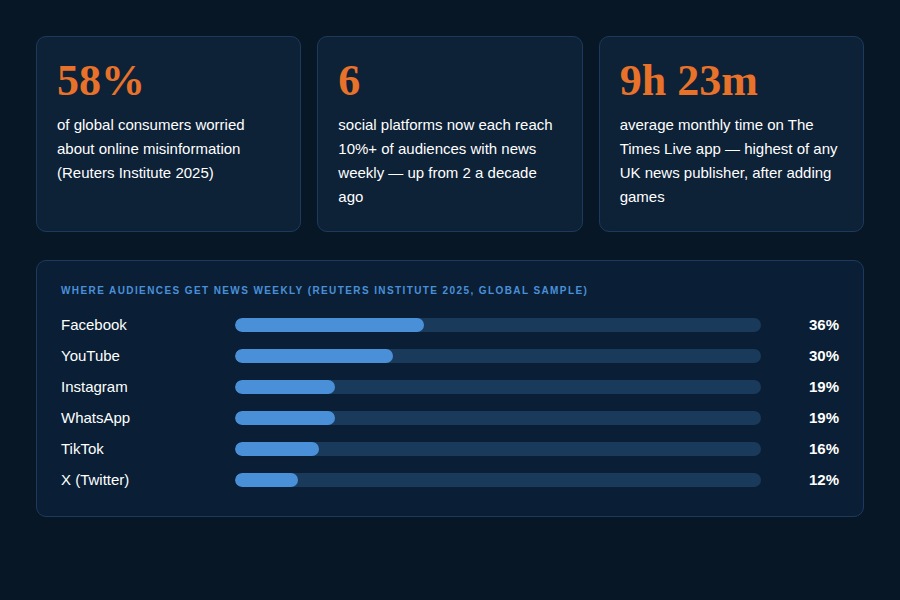
The six social platforms that each now reach more than 10 percent of global audiences with news every week— up from just two platforms a decade ago — are not neutral infrastructure. They are businesses with their own editorial priorities, their own monetisation models, and their own relationship with publishers, which has historically been extractive.
Every reader you reach through a social platform is a reader whose relationship with you is mediated by that platform. The platform controls the algorithm that decides whether they see your content. The platform controls the data generated by their engagement. The platform can change either of those things at any time, without notice, in ways that have nothing to do with the quality of your journalism.
A game hosted on your own domain, visited directly by readers who have built a habit around it, sits entirely outside this system. Publishers who are rebuilding their audience around owned channels — apps, newsletters, and direct traffic — are finding that these audiences are more loyal, more willing to pay, and more resistant to platform disruption than audiences built on social referral.
The neutral format, the wider audience
One of the underappreciated benefits of a daily game as an entry point is that it does not require the reader to have an opinion about your editorial stance. A reader who disagrees with your coverage of a local political issue will still play your crossword about their town. A reader who is fatigued by hard news will still engage with a puzzle. The game is politically neutral, anxiety-free, and genuinely fun — which gives it access to audiences that journalism alone cannot reach.
This matters in polarised local markets, where news avoidance is often correlated with political identity. The Reuters Institute 2025 report documents a deep divide in how conservatives and progressives relate to news media, with growing numbers on both sides tuning out. A game that is about the town — its streets, its businesses, its community events, its local government — rather than about political conflict is a format that can reach across that divide.
Trust as a subscription driver
The subscription conversion that follows daily game engagement is different in character from the conversion that follows a viral article. The game player who subscribes is not responding to a moment of peak interest in a particular story. They are formalising a relationship that already exists in practice.
They visit your site every morning. They know your voice. They have encountered your journalism through the puzzle clues. They are, in all meaningful senses, already a committed reader. The subscription is the acknowledgement of that. It is the easiest sales conversation you will ever have.