Designed to drive reader engagement - not dilute it
Why your crossword clue should live inside the article — not outside it
Most news games are decorative. They sit alongside the journalism but are not connected to it. The ones that move the needle are built on the opposite principle: the clue is only solvable if you read the story.
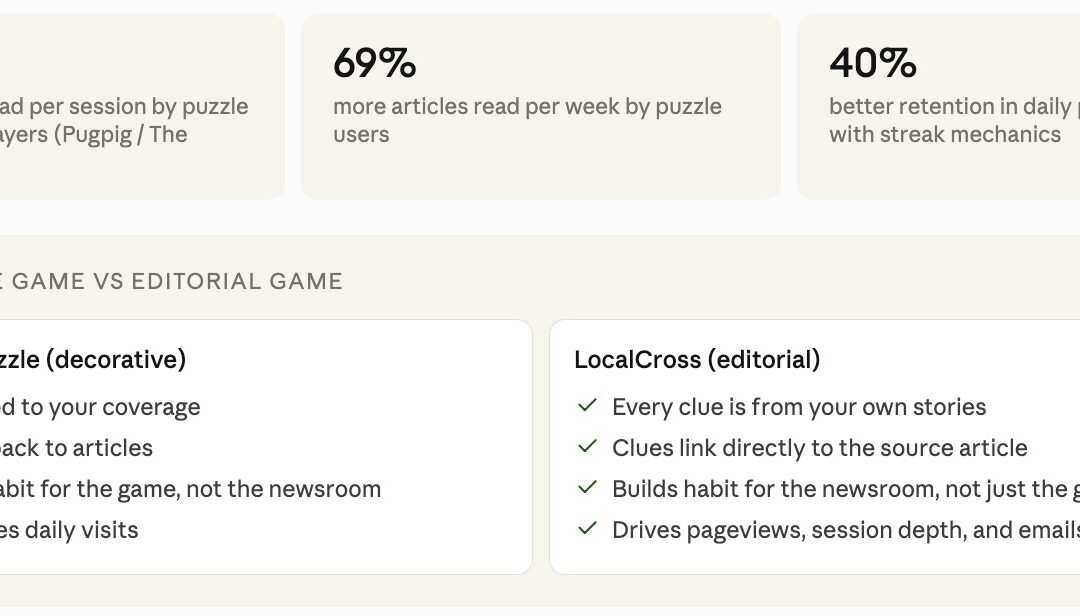
The decorative game vs the functional game
A generic Sudoku on your homepage passes the time. It might even bring people back daily. But it does nothing for your journalism, your pageviews, or your first-party audience, because it has no connection to what you actually do. The game and the content are separate products that happen to share a URL.
A crossword where clue 5-Across is buried in today's city-council recap does something entirely different. It makes reading the article the path to solving the puzzle. The player is not being offered content as a reward for playing. The content is the game.
This distinction sounds simple. It has large consequences. Publishers who have added editorially integrated games report significantly higher article reads per session and per week compared to those running generic puzzle syndications. The engagement difference is not marginal. It is structural.
Three clue types, three depths of engagement
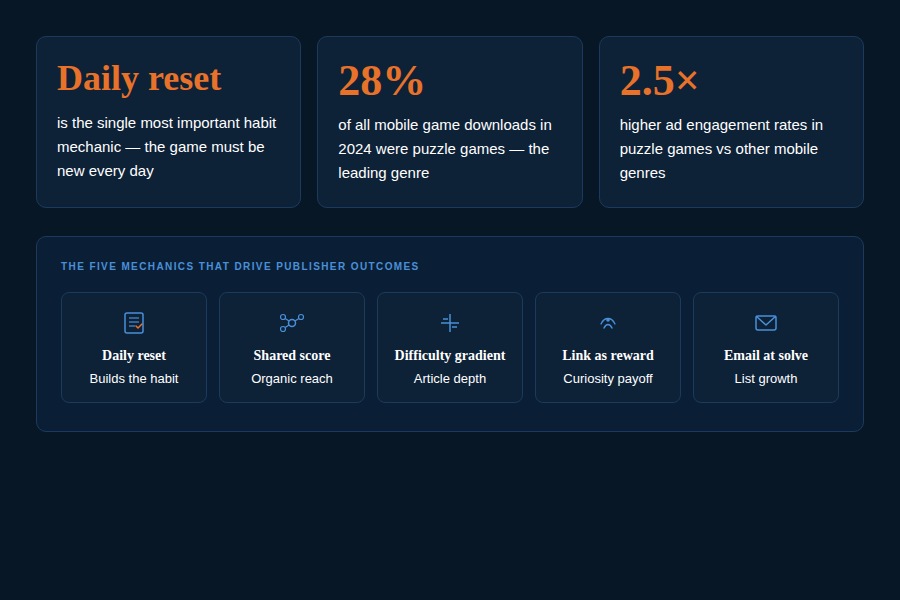
The clue-writing framework matters as much as the editorial integration. Not every clue should require deep reading — that would lose casual players before they develop the habit. The right approach uses three difficulty levels, each keyed to a different depth of engagement with the source article.
Headline clues are easy. The answer is in the headline or the first paragraph. A new reader can get these without opening the article at all — but they have still been exposed to the story, which is worth something.
Article-body clues are medium. The answer requires reading into the piece — finding a name, a number, a place that is specific enough not to be guessable. These clues are the primary traffic driver. The player who cannot immediately answer one has a choice: guess or read. Many read.
Implied clues are hard. The answer is not stated anywhere in the article — it requires connecting the story to a piece of context or background knowledge. These reward the engaged reader and create the most memorable solves. They also create the strongest motivation to click through to the article to understand the connection.
Each difficulty level is a different kind of journalism engagement. Together, they create a puzzle that works for readers at every level of engagement with your coverage — and pulls all of them deeper.
The curiosity debt mechanic
There is a psychological dynamic at work in a well-constructed article-linked clue that is worth naming: curiosity debt. When a clue creates a question the player cannot answer without reading the source material, the player is in a state of motivated uncertainty. They want to know. The article is the only place to find out. The clue has created a debt of curiosity that the article pays off.
This is a fundamentally different mechanism from a standard editorial call-to-action — a "read more" button, a related-story widget, a newsletter prompt. Those ask the reader to make an active choice to go further. A curiosity-debt clue makes not going further feel incomplete. The motivation is internal, not external.
The key design principle is that the clue must be specific enough that it cannot be guessed. A clue that asks for the name of the city councillor who voted against the rezoning can only be answered by someone who read the article. A clue that asks for "the name of a city councillor" is guessable and creates no debt.
Post-solve as the ideal moment
The placement of the article link matters as much as its existence. A link embedded mid-puzzle — before the player has finished — asks them to abandon the game to read the article. Most players will not do that. The link competes with the puzzle for attention, and the puzzle usually wins.
The right moment is after the solve. A player who has just completed a puzzle is in a specific mental state: satisfied, slightly elevated, and — if the clues have done their job — curious. They have been exposed to your coverage through the puzzle. They have unresolved questions about stories they only half-understand. The article links appear now, when the game is done and there is no competing pull.
This is why the Times Live app at The Times saw article reads rise 6 percent and topic readership jump from 2 to 17 percent after integrating games more deeply into its app. The games do not compete with the journalism. They prime the reader for it.
What to measure
The right metrics for a game-to-journalism integration are not game metrics — they are editorial metrics. Daily active players matters, but it is a vanity number unless it is paired with article click-through rate from the game, session depth on those linked articles, and email capture rate.
The question you are trying to answer is: does the game send readers into the journalism, and do they stay when they get there? Those two numbers — click-through rate from the game to the article, and time on page for those sessions — are the signal. Everything else is context.